Why Chip Configuration Defines Color Output in Stage Lights LED Par Fixtures
Anyone who has stood behind a lighting console during a live show knows the frustration of watching a wash that looked perfect in rehearsal turn muddy under camera. Stage lights LED fixtures promise consistent color, but the real story sits inside the chip itself. The LEDPAR 18, an 18-source indoor par can, is a useful case study for understanding what actually controls color behavior on stage.
The Real Problem: Uneven Color on Stage
Lighting designers rarely complain about brightness. They complain about color drift, banding, or washes that shift tone as a fixture warms up. This is not a cosmetic issue. It changes how skin tones read on camera and how saturated colors hold across a large venue.
Inside Multi-Chip Color Mixing
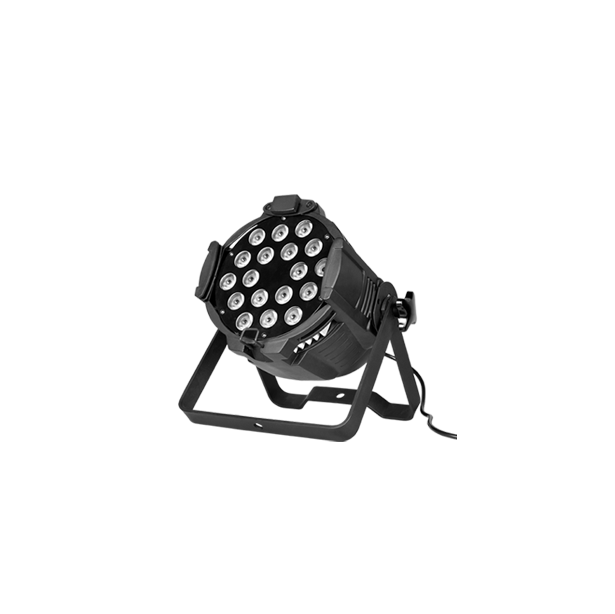
The LEDPAR 18 uses 18 LED sources, offered in 4-in-1, 5-in-1, or 6-in-1 configurations. Each configuration combines more individual color emitters — red, green, blue, and in some versions colors such as amber, white, or UV — into a single LED package. More emitters in one package generally expand color-mixing options, since the fixture can blend more wavelengths before the light leaves the lens.
That said, chip format alone does not guarantee smooth mixing. Secondary optics and diffusion in front of the LEDs matter just as much. Without proper beam shaping, a 6-in-1 package can actually produce visible color fringing at close range, something a well-designed 4-in-1 unit might avoid entirely.
Heat, Chips, and Color Stability
Here is the part most buyers overlook. LED output and chromaticity can shift as junction temperature rises — a well-documented behavior in solid-state lighting, not a marketing claim. A cool blue can drift slightly after twenty minutes of continuous use if thermal management is weak.
This is why the LEDPAR 18 relies on an aluminum die-cast heat sink integrated into the housing rather than a bolted-on afterthought. Aluminum die-casting spreads heat across a larger surface area quickly, which helps keep chip temperature more stable during long cue stacks or multi-hour broadcasts.
Beam Angle and Dimming in Practice
A 25-degree beam angle, with 15 or 45-degree lens options, determines how tightly the light concentrates on a subject versus spreading across a stage. Combined with 0-100% linear dimming, this lets an operator hold a precise light level without visible stepping, which matters enormously for close-up broadcast shots where any flicker or jump reads instantly on camera.
Strobe performance up to 25Hz adds another layer for concert use, where fast pulsing effects need to stay clean rather than smeared. Flicker-free performance depends mainly on the fixture’s driver and dimming method, which is what protects footage from rolling bands during TV studio recording.
Comparing 4-in-1, 5-in-1, 6-in-1 Setups
| Configuration | Wattage per LED Package | Total Power Draw | DMX Channels |
|---|---|---|---|
| 6-in-1 | 18W | 220W | 10 |
| 5-in-1 | 15W | 180W | 9 |
| 4-in-1 | 10W | 150W | 8 |
More complex LED packages often come with additional control requirements, which is one reason channel counts can increase across different versions of the same fixture. A 6-in-1 setup gives broader color-mixing flexibility but also draws more power and places more demand on thermal design, which loops back to why the heat sink matters so much in this product line.
FAQ: Common Questions on Chip Configuration
Does a 6-in-1 chip always produce better color mixing than a 4-in-1?
Not automatically. More emitters expand color options, but mixing quality also depends on lens diffusion and beam throw distance. At short range, a poorly diffused 6-in-1 unit can show more color separation than a well-engineered 4-in-1 fixture.
Is the IP20 rating suitable for outdoor stage setups?
No. IP20 means the fixture is built for dry, indoor environments only — concert halls, TV studios, and architectural interiors, which matches the LEDPAR 18’s intended use. Any outdoor deployment would require a separate weatherproof enclosure rated for dust and moisture exposure.
Color accuracy in stage lights LED fixtures is rarely about a single spec on a data sheet. It is the interaction between chip configuration, thermal design, and optics working together over hours of continuous operation. For anyone comparing LED stage wash lights or indoor LED par cans, that interaction — not the chip count alone — is what determines whether a wash still looks right an hour into the show.
Other News
-
Is this Beam+Spot+Wash Hybrid Moving Head compliant with EU rules?
-
Can we pay the balance after inspecting the LED Profile Light order?
-
Are there any local compliance issues with this LED Effect Light?