Segmented Luminance and Environmental Resilience: Decoding the BARSTROBE 300IP
In the high-stakes environment of outdoor music festivals and large-scale touring, the requirements for led stage lights have evolved far beyond basic illumination. Designers now demand surgical precision in light distribution and a structural integrity that can withstand the unpredictable nature of open-air production. The BARSTROBE 300IP emerges as a technical solution to these demands, predicated on a high-density segmented architecture and a chassis engineered for rigorous IP65 compliance.
The Physics of Pixelation: 23/46 Segment Control
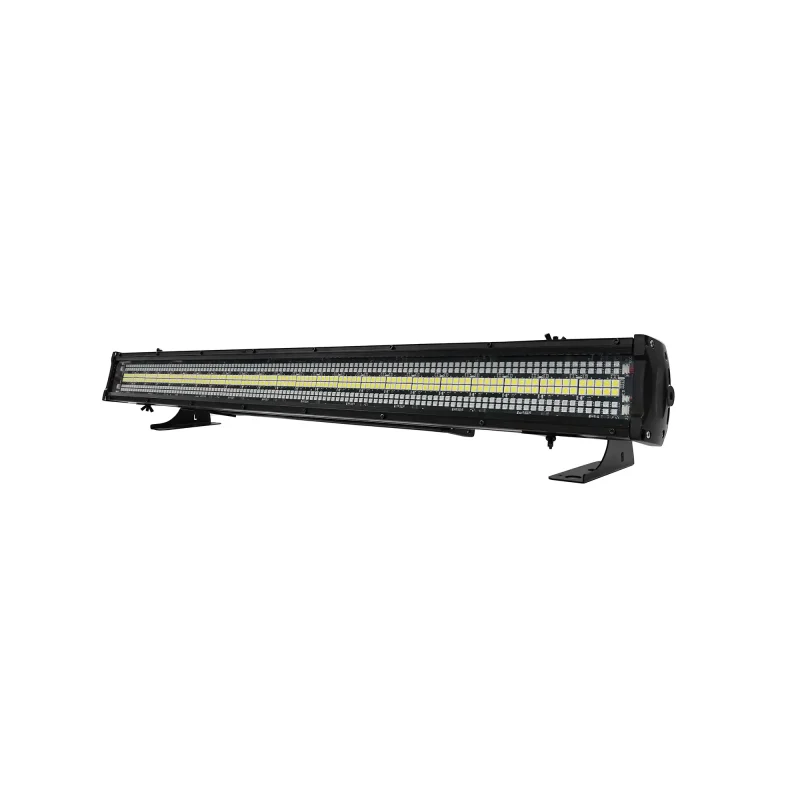
At the heart of the BARSTROBE 300IP’s versatility is its sophisticated segmented control system. Unlike traditional strobe units that operate as a single monolithic block of light, this fixture bifurcates its output into two distinct layers. The primary strobe consists of 230 individual 3W Cool-White (6500K) LEDs, mapped into 23 independent controllable segments. Parallel to this, an auxiliary RGB array featuring 460 3in1 LEDs is organized into 46 segments.
This level of granularity allows lighting programmers to treat the strobe bar not just as a flash unit, but as a low-resolution pixel-mapped surface. By manipulating these 69 total segments, one can generate complex chasing patterns, geometric pulses, and fluid color transitions that correlate with the rhythmic transients of a performance. This eliminates the “flatness” often associated with high-power strobes, providing a three-dimensional depth to the stage design.
Sealing the Intensity: Die-Cast Aluminum Engineering
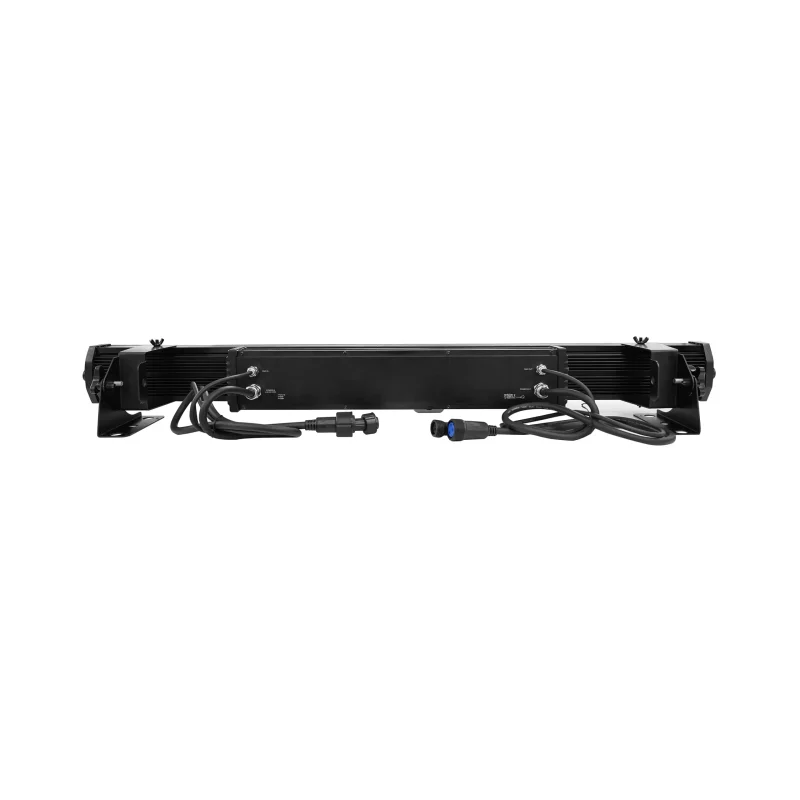
Maintaining high-power LED performance in an outdoor setting is a battle against thermal buildup and environmental ingress. The BARSTROBE 300IP utilizes a die-cast aluminum housing that serves as both a protective shell and a massive passive heat sink. Die-casting ensures that the skeleton of the fixture is a single, continuous piece of metal, reducing the number of potential leak points and providing a stable foundation for the optics.
The IP65 rating signifies that the internal electronics are completely dust-tight and protected against water jets from any direction. This is achieved through a combination of precision-machined mating surfaces and high-tension silicone seals. For road shows where gear is often exposed to rain, dust, and coastal salt spray, this resilience is not just a feature—it is a baseline requirement for professional led stage lights.
| Feature Group | Technical Specification |
|---|---|
| Main Strobe Array | 230 x 3W Cool-White (6500K), 23 Segments |
| Auxiliary RGB Array | 460 x 0.5W RGB 3in1, 46 Segments |
| Projection Angle | 100° Wide-Angle Coverage |
| Ingress Protection | IP65 (Dust-tight and Water-resistant) |
| Power Consumption | 140W (Steady) / 360W (Peak Strobe) |
Dynamic Shutter Effects and Linear Dimming
A strobe’s effectiveness is measured by the sharpness of its transients. The BARSTROBE 300IP features a high-speed electronic shutter capable of frequencies between 0 and 25Hz. Because the system is entirely LED-based, there is no “recharge time” or capacitor lag typical of discharge-style strobes. This allows for instantaneous pulse effects and high-frequency “shivering” strobes that remain perfectly synchronized across multiple units via DMX512 or RDM protocols.
The dimming curve is equally refined, offering a 0-100% smooth linear transition. In professional environments, the ability to fade a strobe bar down to a dim, saturated glow for atmospheric sequences is just as vital as the ability to deliver a retina-searing flash. This linearity ensures that color mixing in the RGB auxiliary layer remains consistent across the entire intensity range, avoiding the “stepping” or flickering often found in lower-tier fixtures.
FAQ: Professional Technical Considerations
Q: Can the BARSTROBE 300IP be used as a constant-on wash light?
A: Yes. While optimized for strobe transients, the advanced cooling system allows for a steady “full-on” state at 140W. This makes it an effective tool for audience blinders or high-intensity flood lighting in outdoor architectural applications.
Q: Does the 100° projection angle limit its throw distance?
A: The wide angle is designed for maximum coverage at mid-to-short range. It is intended to saturate a large stage area or a wide section of a crowd. For long-throw “needle” beams, a dedicated beam moving head would be a more appropriate choice.
Q: Is it necessary to use a specific DMX mode for segment control?
A: To access the full 23/46 segment mapping, the fixture must be set to its highest DMX channel mode (161CH). For simpler applications where individual segment control is not required, lower channel modes are available to conserve DMX real estate.
Final Thoughts on High-Performance Integration
The integration of high-power strobe capability with detailed pixel-mapping segments marks a significant shift in how we deploy led stage lights for modern events. The BARSTROBE 300IP provides a tool that respects both the aesthetic needs of the lighting designer and the practical constraints of the technical crew. Its ability to survive the rigors of the road while delivering nuanced, controllable intensity makes it a high-trust asset for any production inventory.
By focusing on the engineering details—the segment density, the thermal dissipation of the die-cast frame, and the precision of the electronic shutter—it moves beyond being a simple utility and becomes a fundamental element of visual storytelling. In the world of professional production, reliability is the silent partner of creativity, and the BARSTROBE 300IP is designed to be a very reliable partner indeed.
Other News
-
Does this LED Effect Light work well in high humidity venues?
-
Is this Beam+Spot+Wash Hybrid Moving Head compliant with EU rules?
-
Can we pay the balance after inspecting the LED Profile Light order?